Every nail is a decision
Whether a part of a house can ever be repaired, moved or used again is settled by how it was fastened. A six-rung ladder makes that choice visible.
 one fastener at a time
Take a floor apart in a house built last year and you will find the plywood glued to the joists and pinned with ringed nails. It makes a quiet floor. It also means the plywood comes up in splinters and the joists come out fouled with glue. Two good materials have been turned into one piece of waste, by a choice nobody thought of as a choice.
Most of a modern house is joined this way. Glue, foam and sealant are cheap and fast, and they forgive a poor fit. That is why so much of a building is, in effect, welded to itself.
Three questions for any joint
Before we draw a detail, we ask three things.
- Can this part be removed without damaging itself or its neighbors? If not, the fastener is wrong.
- Can it be removed without first destroying something that should last longer? If not, the order of the layers is wrong.
- Will the person removing it in sixty years know that it can be, and how? If not, the record is missing.
The first question can be graded. We use a ladder.
The ladder
| Rung | How it is joined | For example | What you get back |
|---|---|---|---|
| 0 | Cast or welded in place | Concrete poured around steel; welded frames; brick in cement mortar | Rubble |
| 1 | Glued | Stuck-down flooring; spray foam; adhered roofing | Only the thing it was stuck to, after cleaning |
| 2 | Nailed | Framing, sheathing, siding | A sound board or a split one, depending on the nail |
| 3 | Screwed or bolted | Screws, bolts, clips, metal hangers | The part, at close to full value |
| 4 | Held dry | Clipped cladding; floating floors; lay-in ceilings; timber joinery | The part, quickly and whole |
| 5 | Joined by a separate bracket | A shoe or plate that joins two untouched members | Both parts, and often the bracket |
The rule is short. Use the lowest rung that does the job, and write down why.
The nail is not the villain
It is tempting to conclude that screws are good and nails are bad. That is wrong, and acting on it would cost a great deal for very little.
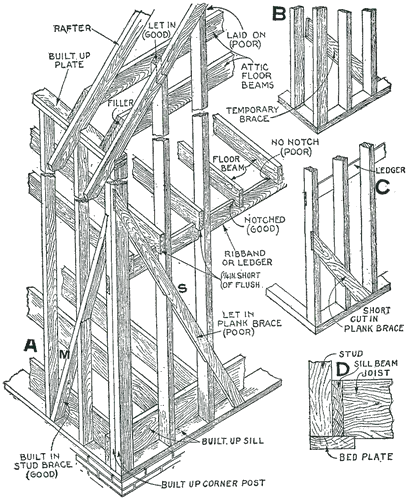
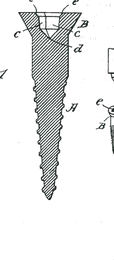
A plain, smooth nail in softwood pulls out about as easily as a screw. That is how salvage crews recover framing today. The trouble is the ringed nail, the staple, the nail driven too deep, and above all the nail driven through glue. Those behave like rung 1.
There is a second reason to be careful. The walls that hold a house up in an earthquake are tested as exact recipes, and those recipes are written with nails. Swap in screws and the wall is no longer the one that passed the test. So, on those walls we use the specified nail, count the wall as permanent and keep such walls few.
Chasing the last ten percent is what makes this look expensive.
How far to take it
Not to the top of the ladder. A building that reaches rung 3 or better across nine-tenths of its material, with a handful of permanent parts written down, can truly be taken apart and used again. The last tenth is where the cost and the arguments live.
Most of the work is drawing, not spending. Choosing a smooth nail over a ringed one is free. Screwing a subfloor over a rubber mat, in place of glue, costs a little labor. The expensive part is doing an unfamiliar thing for the first time.
What we don’t know
We have drawn these details. We have not yet lived with them for decades, and nobody has. Screws rust, wood shrinks onto them, paint fills their heads. A joint that could come apart in theory, but slowly, will be met in sixty years by someone with a wrecking budget. That worry has its own question.
Drafted with AI assistance from Viridian's working papers and detail guides, then read, corrected and approved by Keith Cash, co-founder. Found a mistake? Tell us.